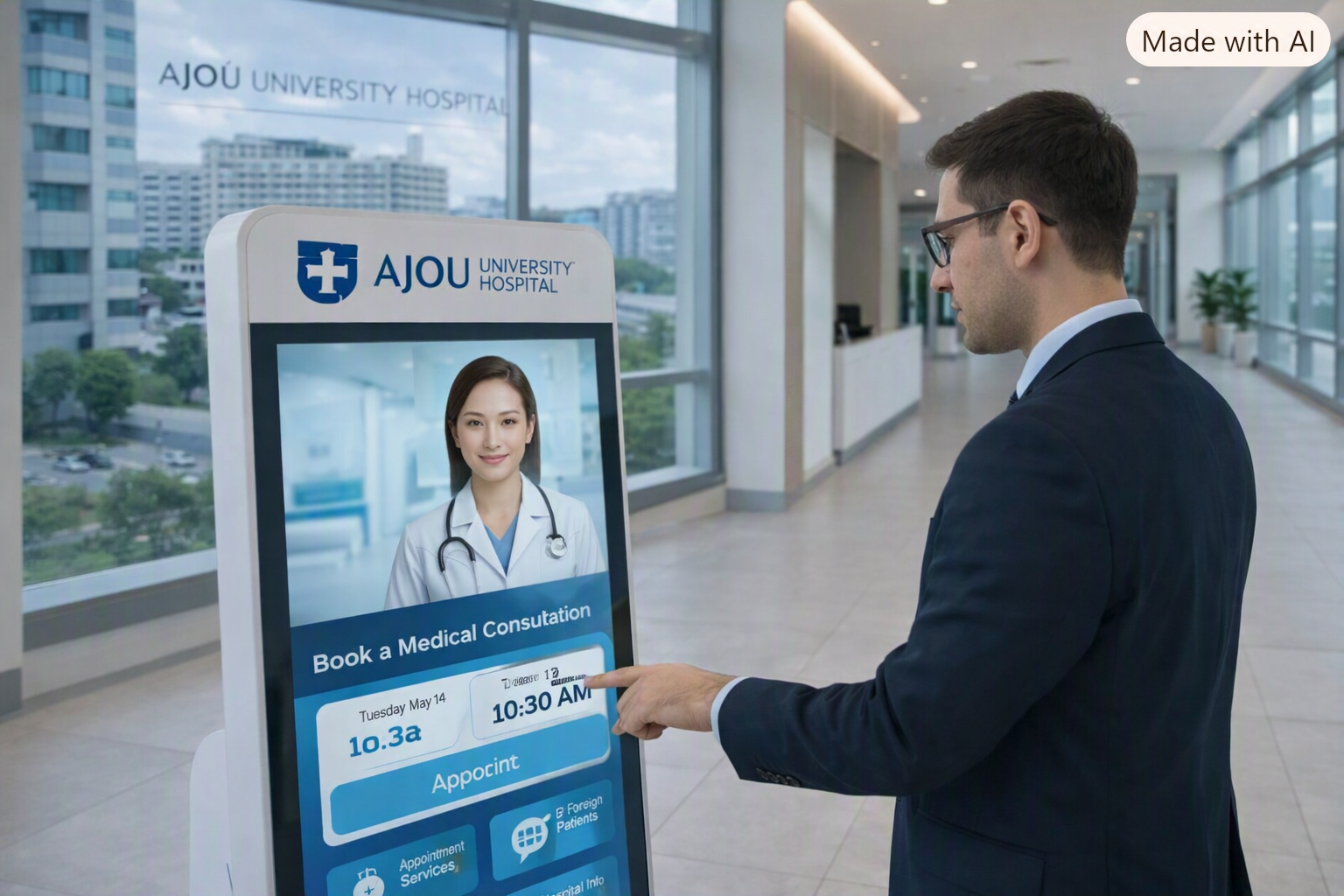
Imagine arriving at a major hospital in South Korea, uncertain about which department to visit, which doctor to see, or how to navigate a complex healthcare system in a foreign language — and having all of that answered instantly by a friendly, intelligent virtual assistant. That future is already here. Ajou University Hospital in Suwon, South Korea, has just debuted a cutting-edge virtual assistant kiosk designed to guide patients through their hospital journey, and the healthcare world is paying close attention.
What Is Ajou Hospital's Virtual Assistant Kiosk?
Ajou University Hospital, one of South Korea's most respected academic medical centers, has introduced an AI-powered virtual assistant kiosk for patient use within its facilities. As reported by Healthcare Asia Magazine, the kiosk uses conversational AI technology to interact with patients in real time, providing guidance on department selection, appointment information, hospital navigation, and general health service queries. The system is designed to reduce wait times, ease patient anxiety, and streamline the often confusing process of entering a large hospital environment.
The virtual assistant is built to respond to natural spoken or typed language, making it accessible to a wide range of users — including elderly patients, first-time visitors, and critically for Le Medica's community, international patients who may not be fluent in Korean. While full multilingual capability details are still emerging, the hospital's focus on patient-centered innovation strongly signals that language accessibility is a core design priority.
Why Ajou University Hospital Matters in Global Healthcare
Ajou University Hospital is not a newcomer to medical innovation. Founded in 1994 as part of Ajou University in Suwon, Gyeonggi Province, it has grown into a 1,200+ bed tertiary care facility with internationally recognized departments in oncology, cardiology, neurology, organ transplantation, and robotic surgery. South Korea's healthcare system consistently ranks among the top in Asia for technology adoption, patient outcomes, and cost-effectiveness — making hospitals like Ajou compelling destinations for international patients seeking world-class treatment.
South Korea has also made significant national investments in healthcare AI and digital transformation. The government's commitment to smart hospital infrastructure means that Ajou's virtual kiosk debut is not an isolated experiment — it is a glimpse into where Korean hospital care is headed system-wide.
Why This Matters Now
The debut of Ajou Hospital's virtual assistant kiosk arrives at a pivotal moment for medical tourism in Asia. Post-pandemic, international patient volumes to South Korea, Malaysia, Thailand, Taiwan, and China have rebounded strongly — and patients are arriving with higher expectations than ever before. They want seamless communication, reduced friction at the point of care, and technology that meets them where they are.
According to the Korea Health Industry Development Institute (KHIDI), South Korea welcomed over 600,000 foreign patients in a recent reporting year, with numbers climbing steadily. The top origin countries include the United States, China, Russia, and nations across Southeast Asia and the Middle East. For these patients, navigating a hospital in an unfamiliar country is one of the most commonly cited stress points — and AI-powered kiosk tools like Ajou's directly address that barrier.
This development also signals a broader trend: Asian hospitals are racing to become the most technologically advanced patient destinations in the world. For international patients comparing treatment options across borders, this kind of smart infrastructure is increasingly part of the decision-making equation — not just clinical outcomes and price.
How Technology Like This Transforms the International Patient Experience
For international patients, hospital navigation in a foreign country can feel overwhelming. Language barriers, unfamiliar systems, long check-in lines, and uncertainty about where to go or who to speak with are all common pain points. A well-designed virtual assistant kiosk can address several of these challenges simultaneously.
Consider what a smart kiosk can do for an international patient arriving at Ajou for a cardiac evaluation, an oncology consultation, or a robotic orthopedic procedure:
Instantly identify the correct department and direct the patient to the right floor or clinic
Confirm appointment details and check-in status without standing in long queues
Provide real-time information about estimated wait times
Answer common questions about hospital amenities, payment options, and interpreter services
Offer basic health triage information to help patients understand urgency and next steps
When multilingual support is fully integrated — as many Korean hospitals are actively developing — this kind of tool becomes a genuine lifeline for English-speaking patients from the US, UK, Australia, Canada, or elsewhere who are seeking care in South Korea.
What This Means for Medical Tourists Considering South Korea
South Korea is already renowned globally for several medical specialties. Patients typically travel there for cosmetic and reconstructive surgery, cancer treatment, fertility procedures, cardiac surgery, and cutting-edge diagnostics. Treatment costs in South Korea are generally 40–70% lower than equivalent procedures in the United States, even after factoring in flights and accommodation. For example, a cardiac bypass procedure that may cost $150,000 USD or more in the US can often be performed at a top Korean hospital for $25,000–$45,000 USD, with comparable or superior outcomes.
Hospitals like Ajou that invest in patient-facing technology — from AI kiosks to robotic surgical systems to digital health records — are actively distinguishing themselves as destinations where quality of care and quality of experience are taken equally seriously. For international patients, that combination is enormously reassuring.
How Le Medica Helps International Patients Access Top Korean Hospitals
At Le Medica, we specialize in helping English-speaking patients navigate exactly this landscape. Whether you're considering Ajou University Hospital in South Korea or partner hospitals in Malaysia, Thailand, Taiwan, or China, our concierge team handles every detail — from comparing treatment options and verifying hospital credentials, to coordinating appointments, arranging medical translators, and supporting your logistics on the ground.
We stay on top of developments like Ajou's virtual assistant kiosk debut because these innovations matter to our patients. A hospital that invests in smart patient infrastructure is a hospital that takes the full patient journey seriously — and that's exactly the kind of institution we're proud to connect our clients with.
Frequently Asked Questions
What is the Ajou Hospital virtual assistant kiosk?
The virtual assistant kiosk recently debuted at Ajou University Hospital in Suwon, South Korea, is an AI-powered interactive terminal that helps patients navigate the hospital, find the right departments, check appointment details, and access general health service information. It is designed to reduce confusion and wait times, particularly for first-time and international visitors.
Does Ajou University Hospital treat international patients?
Yes. Ajou University Hospital has an established international patient center that assists foreign visitors with appointment coordination, translation services, and tailored care pathways. The hospital treats patients from across Asia, the Middle East, and Western countries in specialties ranging from oncology and cardiology to orthopedics and transplant medicine.
How much does treatment at Ajou Hospital cost compared to the US?
Treatment costs at Ajou University Hospital and comparable South Korean institutions are typically 40–70% lower than equivalent procedures in the United States. For example, complex cancer treatments, cardiac surgeries, and advanced diagnostic workups that would cost tens or hundreds of thousands of dollars in the US are often available in South Korea at a fraction of that price, without compromising on quality or technology.
How can Le Medica help me get treatment at Ajou or another top Asian hospital?
Le Medica's concierge team works directly with you to understand your diagnosis, treatment needs, and preferences. We then compare vetted options across our hospital network in South Korea, Malaysia, Thailand, Taiwan, and China — arranging consultations, coordinating medical records transfer, organizing travel and accommodation logistics, and providing English-language support throughout your entire care journey.
Ready to Explore World-Class Care in Asia?
Whether the innovation at Ajou Hospital has caught your attention or you're already exploring treatment options across Asia, Le Medica is here to make your medical journey seamless, informed, and stress-free. Our team of experienced medical travel coordinators is ready to answer your questions, compare your options, and help you access the best care available — at a price that makes sense. Contact Le Medica today to start your consultation and take the first step toward better health, with confidence.
References
Healthcare Asia Magazine. Ajou Hospital debuts virtual assistant kiosk for patients - Healthcare Asia Magazine [Internet]. 7 Aug 2026. Available from: https://news.google.com/rss/articles/CBMipwFBVV95cUxQRWdxd1FOeUN5NWZScVJQOEQ3RWFVLWxZMDlLSnBDblZtVXEyRWFDQVA4bHJFVTFOT3A5NjRZOW1YRDNnRXJ2WnJBMEhIRmdVOFdMTTFmeXp2eXIwR2x3YU9HUm5wQmdxMTRMb2lZczFfcWNRbUdKSXhMdFVQdDI2MDdvUzhXcHpyZjBjTDRLUURFMzNFZGpKYUFrczRHS0xyeUM0Y3FJVQ?oc=5